The Environmental Reality of Building in Kerala
Kerala's tropical maritime climate is world-renowned for lush monsoons and coastal serenity, but for residential architecture, it poses a distinct set of engineering challenges. With relative humidity regularly climbing above 85% for six to eight months every year, doors are frequently the first interior and exterior elements to suffer from environmental degradation.
Homeowners and architects frequently encounter:
- Seasonal Expansion and Jamming: Solid timber absorbs moisture from atmospheric humidity, causing door shutters to bind against their frames during peak monsoon months.
- Warping and Delamination: Uneven moisture exposure between air-conditioned interiors and humid exterior corridors creates stress differentials that bow conventional doors.
- Termite & Fungal Vulnerability: Tropical dampness creates the ideal breeding ground for subterranean termites and wood-decay fungi.
- Master Suite & Bathrooms: Where high internal humidity from walk-in wet showers meets conditioned sleeping spaces.
- Balcony & Terrace Entrances: Exposed directly to wind-driven tropical rainfall.
- Pantry & Utility Areas: Demanding rigorous daily sanitation and resistance to cleaning agents.
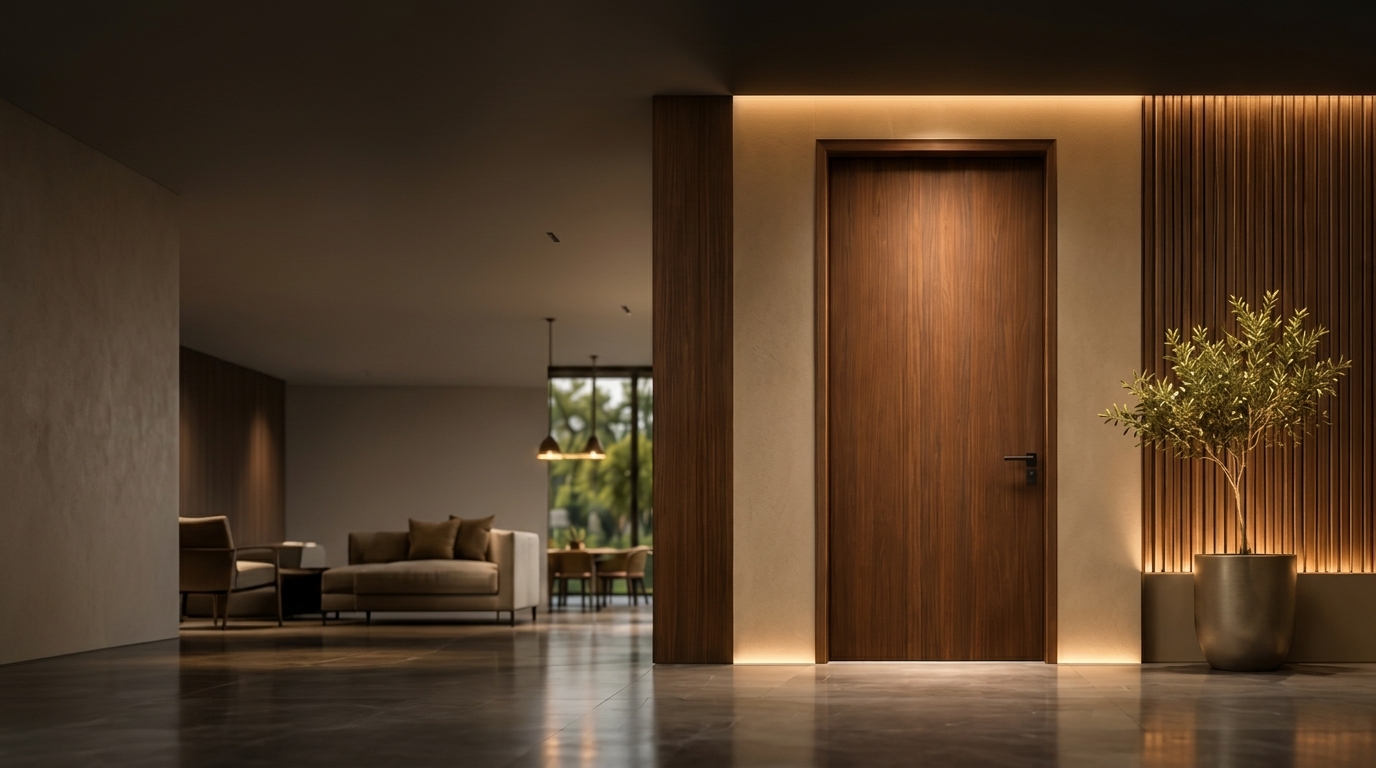
- Architectural Main Doors: Engineered WPC cores with high-security multi-point locking systems and bookmatched natural veneer overlays.
To resolve these perpetual challenges without compromising the refined visual warmth of architectural timber, Wood Plastic Composite (WPC) doors have emerged as the premier contemporary alternative.
What Exactly is WPC (Wood Plastic Composite)?
WPC is an engineered composite material synthesized from virgin polymers, recycled wood fibers, and specialized coupling agents pressed under high-density extrusion processes.
Unlike hollow PVC doors commonly restricted to low-budget utility areas, high-density architectural WPC possesses the tactile weight, density (0.75 - 0.90 g/cm³), and screw-holding capability of premium hardwoods like Teak and Mahagony, while remaining completely impervious to water and biological pests.
Direct Comparison: WPC vs Traditional Solid Timber
| Performance Parameter | Traditional Solid Timber (Teak / Mahogany) | High-Density Architectural WPC |
|---|---|---|
| Water Absorption Rate | 15% – 35% (leads to seasonal swelling) | < 0.5% (virtually zero water uptake) |
| Monsoon Expansion | Expands by 3mm – 6mm, causing sticking | 0% dimensional change year-round |
| Termite & Borer Resistance | Requires periodic chemical toxic treatments | 100% naturally termite-proof |
| Maintenance Cycle | Sanding and repolishing every 2–3 years | Wipe-clean surface, zero repolishing |
| Fire Retardant Classification | Highly combustible unless treated | Self-extinguishing (Class B1 standard) |
| Environmental Footprint | Depletes old-growth hardwood forests | Recyclable composite, eco-sustainable |
Aesthetics: Does WPC Look and Feel Luxurious?
Modern architectural doors from ROEL Home Solutions bridge this divide through advanced composite engineering:
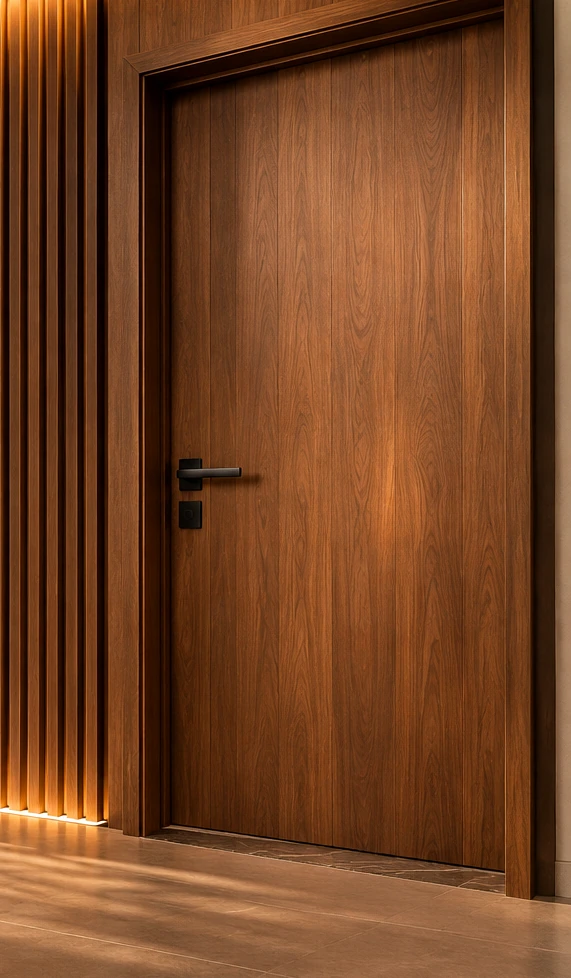
1. Natural Wood Veneer Pressing: Our engineered WPC sub-cores can be laminated with genuine natural wood veneers (American Walnut, Smoked Oak, Teak, and Ash), providing the authentic grain of real timber backed by an indestructible core.
2. Fluted and Textured CNC Milling: The high material density of WPC allows precision 3D CNC grooving, creating fluted architectural doors and shadow-line minimalist designs impossible with brittle conventional materials.
3. Seamless Color & Texture Matching: Door jambs, architraves, and wall paneling can be harmonized with consistent architectural finishes across your entire home.
Ideal Applications Throughout Your Residence
Have questions about material specs or wish to feel physical door cross-sections? Visit the ROEL Home Solutions design studio on NH-66, Kochi or request an architectural consultation below.
Have questions about this material for your home?
Our Kochi showroom features full-scale physical samples of all architectural doors, acoustic fluted slats, and natural surface slabs referenced in this article.